
NYCHAPS Rev War Project Vol 1.1
Independence Day may be July 4, 1776, but the events that led to independence began much earlier. Well before the start of the revolution, the colony of Pennsylvania was involved in the discussions and debate that took place across and within the colonies regarding the conflict between British rule and colonial rights.
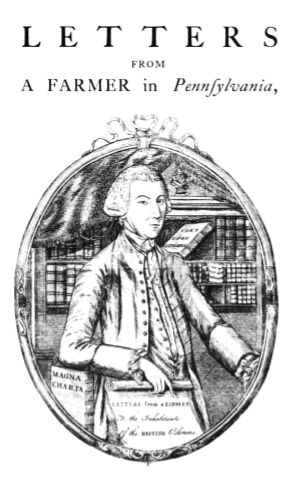 For instance, John Dickinson, a well-known Pennsylvania figure for whom Dickinson College is named, wrote in opposition to the Stamp Act of 1765. In 1768, Dickinson penned “Letters from a Farmer in Pennsylvania.” Published in newspapers throughout the colonies, Dickinson articulated the arguments against the new import taxes brought about by the 1767 Townshend Act. The colonists began to boycott British goods and in 1770 Parliament repealed all the import duties except those on tea. While tensions abated for a time, the Tea Act of 1773, the resultant Boston Tea Party in December of 1773 and the subsequent punitive British response, brought about a call for a colonial conference, or “Continental Congress” to consider next steps.
This First Continental Congress was held in Philadelphia in September and October of 1774. The Congress approved the formation of the “Continental Association” charged with the enforcement of a mercantile boycott of British goods, urged the colonies to organize central and local committees of Associators and called for a Second Continental Congress in the spring of 1775. The Pennsylvania Assembly promptly endorsed the actions of the Continental Congress, becoming the first colonial legislature to do so.
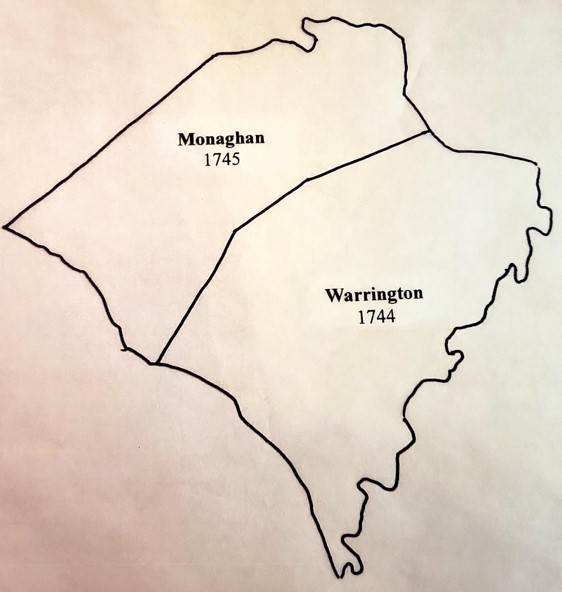
What part did Monaghan and Warrington Townships play in the years before the start of armed conflict? At the time, they were the only two townships in northern York County and the population of the townships was small. In 1775, Monaghan Township’s population was likely between 1,000 – 1,200 people, and Warrington Township’s was roughly 900 – 1,100 residents. In comparison, York County’s total population was around 25,000 – 30,000.
Nevertheless, as townships in the County, each had representation on the County’s Committee of Observation, which was formed at a “General Meeting of the Inhabitants” in December 1774 after the close of the First Continental Congress.
 Each of Pennsylvania’s counties set up a Committee responsible for enforcing the boycotts, monitoring merchant compliance, and discouraging Loyalist activity. In addition to the township representatives, members of the York County Committee included local and civic notables such as James Smith (signer of the Declaration of Independence), Henry Miller and Thomas Hartley who went on to Revolutionary War fame, Archibald McClean, famed surveyor of the Mason-Dixon line, and locally familiar names such as Eichelberger and Dill.
Committee member George Eichelberger was a prominent merchant in York Town, rather than Warrington or Monaghan Township, and was a quartermaster during the war years. He was part of the same extended German immigrant family that, in 1800, acquired Dill’s Tavern in Dillsburg. As for the townships, Warrington Township’s representative was William McCllellan, a local farmer. According to land records and 1780 tax records, he owned almost 300 acres near Round Top Mountain. Monaghan’s representative was James Dill (1720-1796), a Scots-Irish land owner and tavern keeper of a predecessor tavern to Dill’s Tavern. He was one of six sons of the early Monaghan Township settler, landowner and justice of the peace, Captain Matthew Dill, Esq. who purchased 500 acres and settled in the township in the early 1740’s.
As events continued to unfold in 1775, it became apparent that the colonists needed to prepare for a potential armed conflict with England, and Pennsylvania began to organize. Associator units were revived or newly organized with volunteers. Ultimately, fifty-three battalions of military “Associators” were formed in Pennsylvania. On June 30, 1775, Pennsylvania’s Provincial Assembly gave official recognition to the Associators through the passage of legislation which recognized “the Association entered into by the good people of this Province for the Defense of their Lives, Liberty and Property.” The Legislation also established a Committee on Safety, which had authority over Pennsylvania’s military forces until the Militia Act of 1777.
The membership of this Committee was impressive and included such notables Benjamin Franklin (President of the Committee), John Dickinson, Anthony Wayne, William Thompson, Edward Biddle and Robert Morris. York County’s Committee of Observation, which in November 1775 added John Nesbitt of Warrington Township to its ranks, continued to communicate and coordinate with the provincial Committee of Safety.
In a report from September 14, 1775, York County’s Committee reported militia strength of 3,349 Associators and battalion organization to the Pennsylvania’s Committee on Safety. In forming the battalions, “great regard was had to the situation of the County and convenience of the inhabitants.” A prior letter had indicated that Monaghan and Warrington townships would be part of the Fifth Battalion and as of July 28, 1775 the proposed officers for the York County Fifth Battalion included William Rankin as Lieutenant-Colonel, Matthew Dill, Esq. as Colonel, and Robert Stevenson and Gerhard Gress/Graff as Majors. While little has been located on Gerhard Gress, a Robert Stevenson does appear on the tax lists for Warrington Township.
Colonel Mattthew Dill (1726-1812) was another son of Captain Matthew Dill, the early settler of the Dillsburg area, then in Monaghan Township. Colonel Dill also served in the General Assembly in 1777-1779; in 1779, he was appointed sub-lieutenant of York County, to organize the county militia; and he was appointed one of several commissioners to seize the personal effects of Tories in York County. For his service, he was ultimately awarded grants of land in western Pennsylvania.
The Dill family contributed significantly to the early war efforts on behalf of Monaghan Township. Col. Matthew Dill’s son John Dill was a Second Lieutenant in the York Company of Riflemen that marched to Boston in July 1775. His son James (1748-1777), was an officer in the Continental Army, and was killed near Chad’s Ford at the Battle of Brandywine in September, 1777. A son of James Dill, the tavern keeper, reportedly died during the war while on the British prison ship “Jersey.” Other members of the Dill family also served. While Colonel Matthew Dill is buried in the Lower Marsh Creek cemetery in Gettysburg, a marker commemorating his service exists in the Dillsburg cemetery.